
A Secure Neighborhood
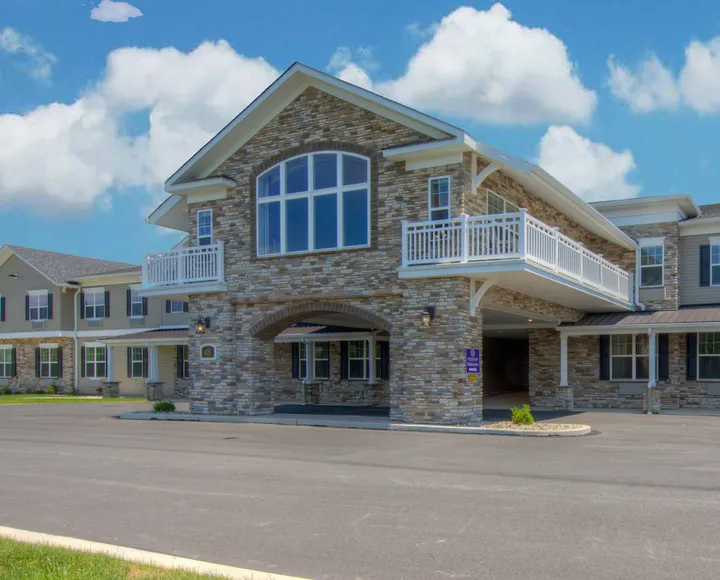
A dedicated, secured area where someone who wanders can move freely and safely, instead of being confined to a room.
Memory Care & Dementia Care · Allentown, PA
If you're watching someone you love change, you don't have to work out the next step alone. Heather Glen offers specialized dementia care in a secure neighborhood, right here in the Lehigh Valley.
Serving the Lehigh Valley
Heather Glen is located in Allentown, PA — serving families throughout the Lehigh Valley, including Macungie, Bethlehem, Emmaus, Whitehall, Easton, Catasauqua and the surrounding townships.
With memory care, being close matters more than people expect. Short drives are what keep visits frequent, and frequent visits are what keep a familiar face in the room.
We'd be glad to answer your questions and help you work out whether memory care is the right next step yet. No pressure, no commitment.
Tell us a little about your loved one and we'll reach out with honest guidance — including whether memory care is the right step yet.
A Heather Glen advisor will be in touch with you within one business day.
Memory Care at Heather Glen
Memory care is not assisted living with a lock on the door. It is a different environment, built around how memory loss changes a day.
A dedicated, secured area where someone who wanders can move freely and safely, instead of being confined to a room.
Caregivers on-site around the clock, trained for the moments that are hardest at home — sundowning, repetition, resistance to care.
Predictable days, familiar faces, and the same sequence each morning. Consistency does more for memory loss than almost anything else.
Built around who your loved one has always been — their history, their habits, what settles them and what sets them off.
Restaurant-style dining with support at the table, because eating often becomes difficult long before anyone mentions it.
In Allentown, convenient for Lehigh Valley families. Frequent, easy visits matter more than you'd think.
“Moving my mom to Heather Glen was the hardest decision I've ever made — and the best one. The staff knew her name from day one.”

For Families Still Deciding
There's rarely one moment that makes it obvious. Most families recognize several of these at once.
If several of these sound familiar, a short conversation can help you understand where your loved one actually is — and whether memory care is the right step yet. There's no pressure to decide anything today.
(610) 841-4478Straight Answers
The questions we hear most, answered plainly — including the ones about money.
Memory care is residential long-term care designed specifically for people living with Alzheimer's disease or another form of dementia. It differs from standard assisted living in three ways: the environment is secured so residents who wander can move about safely, staffing levels are higher and available around the clock, and daily life is deliberately structured around predictable routines that reduce confusion and distress. At Heather Glen, memory care is offered in a secure neighborhood alongside our personal care community.
Assisted living supports people who need help with daily tasks — bathing, dressing, medications — but who are still able to direct their own day. Memory care supports people whose judgment, orientation and safety awareness have been affected by dementia. The practical differences are a secured environment, a higher staff-to-resident ratio, staff trained specifically in dementia behaviors, and programming built for cognitive engagement rather than general recreation. Many families move a parent from assisted living to memory care when wandering, confusion or evening agitation become unsafe.
A nursing home — in Pennsylvania, a skilled nursing facility — provides ongoing medical and skilled nursing care for complex health conditions. Memory care is non-medical residential care focused on supervision, safety and daily support for cognitive decline. Someone with advanced dementia and significant medical needs may require skilled nursing; someone with dementia who is physically well is usually better served in memory care. Heather Glen provides personal care and memory care, not skilled nursing, so if your loved one needs daily medical care we will tell you that plainly rather than take the inquiry.
There is no single threshold, but the signal most families recognize is when safety can no longer be guaranteed at home. Wandering outside, leaving appliances on, medication errors, and agitation that continues through the night are the common turning points. The other signal is the caregiver: when a spouse or adult child is providing supervision that no longer has an end to the day, the arrangement usually stops being sustainable before anyone admits it. Deciding earlier generally means an easier transition, because the person still has the capacity to settle into a new routine.
Memory care typically costs more than assisted living in the same community, because of the higher staffing levels and the secured environment. Pricing varies widely by region, by community, and by how much hands-on care a resident needs, so any figure quoted without knowing your situation is close to meaningless. We will give you Heather Glen's current pricing directly, along with what is and isn't included, on a phone call or a visit — no form-filling required to get a number.
Generally no. Medicare does not pay room and board or long-term custodial care — the daily help with dressing, bathing, eating and supervision that memory care provides. Medicare does cover medically necessary services for someone living with dementia: cognitive assessment and diagnosis, doctor and specialist visits, care-planning visits, mental health care, prescriptions under Part D, hospice for advanced dementia, and a limited skilled nursing stay after a qualifying inpatient hospital admission. Long-term care insurance, veterans' benefits, and personal assets are the usual ways families pay. Confirm your own situation with Medicare or a benefits counselor before relying on any of this.
Visit unannounced if you can, and in the late afternoon — that is when dementia symptoms are often hardest and when staffing is most revealing. Watch whether staff address residents by name and at eye level. Ask what the staff-to-resident ratio is overnight, not just during the day. Ask how long the care staff have worked there, because turnover is the single biggest predictor of quality. Ask what happens when a resident's needs increase, and at what point they would be asked to leave. And notice whether the residents look occupied or parked.
Most families find that a single big conversation goes worse than several small ones. Lead with the specific problem rather than the diagnosis — the stairs, the nights, the driving — and frame the move around what it gives back rather than what it takes away. Avoid arguing about whether the memory loss is real; that argument cannot be won and costs trust. If your loved one is in a later stage, long notice can cause weeks of anxiety without improving the outcome. Our advisors have walked many families through this specific conversation and are happy to talk it through before you have it.
Heather Glen offers both personal care and memory care, so a resident whose needs change can often move between levels of care within the same community and the same familiar surroundings. There are limits: if someone comes to need daily skilled nursing or medical care beyond what a personal care community provides, a different setting becomes necessary. We would rather be clear about that boundary at the start than move a family twice.
Heather Glen is in Allentown, Pennsylvania, serving families across the Lehigh Valley — including Macungie, Emmaus, Bethlehem, Whitehall, Easton, Catasauqua, Coopersburg and the surrounding townships. For families choosing memory care, proximity matters more than it does for other kinds of senior living, because regular visits are easier to sustain when the drive is short.
We're Here to Help
Most people call us long before they are ready to move anyone. That is fine — and often the right time. Our advisors can help you understand what stage your loved one is in, what memory care would and wouldn't change, and what it would cost, without any expectation that you decide today.
If we're not the right fit, we'll say so and point you somewhere that is. Call us or send the short form and we'll reach out within one business day.
For independent information on dementia and caregiving, the Alzheimer's Association (alz.org) runs a free 24/7 helpline at 800-272-3900.
Call (610) 841-4478No pressure, no commitment — just straight answers so you can make the decision that's right for your family.
A Heather Glen advisor will be in touch with you within one business day.